AI legal personhood in Nigeria is the question of whether the law should treat an artificial intelligence system as a legal person, with its own rights and duties. Artificial intelligence now drafts documents, scores loan applicants, steers vehicles and assists in the diagnosis of disease. It does so with a degree of autonomy that earlier tools never had, and that autonomy has prompted a serious question: should the law treat an AI system as a legal person?
This article from The Law Suite examines that question under Nigerian law as it stands in November 2026. It argues that AI does not qualify for personhood, and that conferring it would create more problems than it solves.
Why AI legal personhood in Nigeria matters now
The debate over AI legal personhood in Nigeria is no longer theoretical. Consider three ordinary Nigerian scenarios. A digital lender’s credit scoring system rejects an application on grounds that nobody at the company can fully explain. A bank’s customer service chatbot gives a customer wrong information about a transfer, and the customer acts on it. A lawyer files a brief that cites a Supreme Court decision which turns out never to have existed, because an AI tool invented it.
In each case the person affected will want to know one thing: who answers for this? The question looks simple, but the answer depends on how the law classifies the system that produced the result.
The impact of AI on society is both profound and pervasive. From self-driving cars and personalised recommendation algorithms to predictive analytics in healthcare and automation in manufacturing, AI systems have become part of numerous sectors. They are changing business models and improving efficiency. Yet the same technology raises pressing concerns, among them job displacement, threats to privacy, algorithmic bias and the digital divide. Beneath all of these sits a deeper problem of responsibility, because a system that learns and acts on its own does not fit comfortably into rules written for human actors.
What is a legal person?
In legal terms, a legal person is any individual or entity that the law recognises as capable of owning property, entering contracts, suing and being sued, and bearing rights and obligations. Human beings are legal persons, and so are artificial persons such as companies. One proposed answer to the responsibility problem is to grant AI systems a legal personality of their own. Nigerian law has not yet answered the question of AI legal personhood in Nigeria directly.
The article begins with the concept of legal personhood and examines how Nigerian law confers it on human beings and on companies. It then tests AI against that framework, using the leading company law case of Salomon v Salomon and Co Ltd, the Supreme Court decision in Fawehinmi v Nigerian Bar Association (No 2), and the statutes now governing data, consumers and intellectual property.
Why AI does not qualify
The article weighs the arguments for and against AI personhood. Its central conclusion is that AI should not be recognised as a legal person. The main reason is that personhood would allow the humans behind a system to avoid responsibility. If a developer or a business could point to the AI as the responsible party, the victim would be left facing an entity with no assets, no intentions and no ability to take precautions.
A company, by contrast, is a legal fiction attached to real people. It has members, directors and assets that can satisfy a judgment. An AI system has none of these features, so granting it personality would add a name to the court papers and nothing more. For these reasons, AI legal personhood in Nigeria would create more problems than it solves.
What the article covers
The article also considers the practical questions that Nigerian businesses, lawyers and regulators face today:
- Civil and criminal liability when an AI system causes harm
- Contracts concluded by automated systems
- Authorship and inventorship of AI generated work
- Data protection and automated decision making under the Nigeria Data Protection Act 2023
- The professional duties of lawyers who use AI tools
- Nigeria’s current regulatory position, the African Union’s Continental AI Strategy and the bills before the National Assembly
Key takeaways
- Legal personhood is a status that the law confers for a purpose, and Nigerian courts have said it must come from a recognised legal source.
- AI lacks the moral agency, assets and human structure that justify personhood for human beings and companies.
- AI legal personhood in Nigeria is better replaced by clear human accountability for developers, deployers and operators.
- Recognising AI as a legal person would add ambiguity and give the humans behind it a way to escape responsibility.
- Nigeria should keep treating AI as property and as a tool, and build a clear regime of human accountability covering liability, authorship and oversight.
- Businesses and lawyers who use AI should treat every AI output as their own work, verify it, and allocate liability clearly in their contracts.
Authorship and review
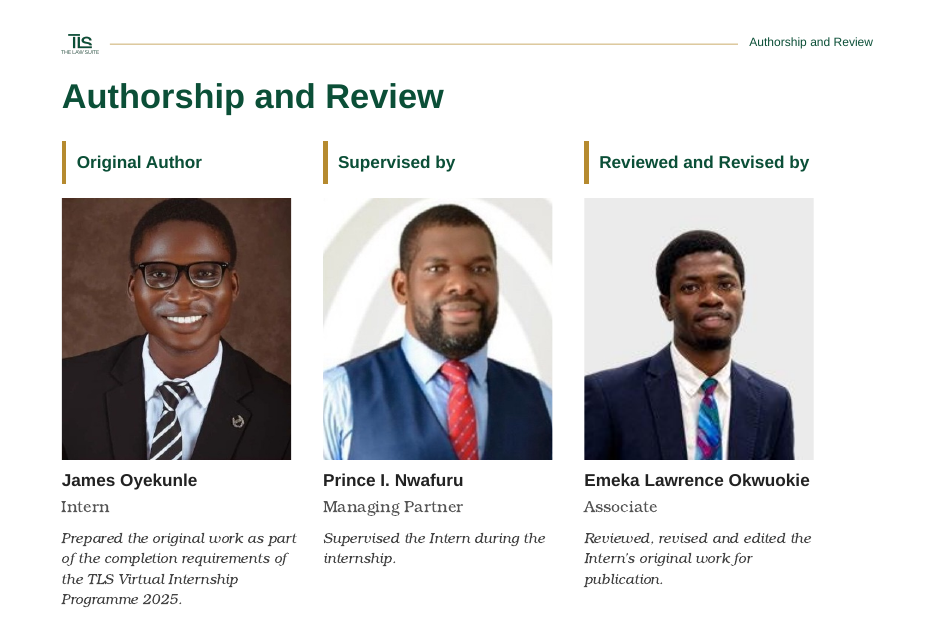
This article on AI legal personhood in Nigeria was prepared as part of the TLS Virtual Internship Programme 2025. Original work by James Oyekunle, Intern, as part of the TLS Virtual Internship Programme 2025. Supervised by Prince I. Nwafuru, Managing Partner. Reviewed and revised by Emeka Lawrence Okwuokie, Associate.